- Published on
McKinsey: Still Stuck 3 Years Later
- Authors
- Name
- Strategic Machines



Circling the Drain
Change is never easy, but this one feels a little existential for some companies.
A little history is needed.
The GPT family of models has been around since 2018 but caught the attention of IT professionals in 2020 when GPT-3 arrived. It was then that code generation and other low-level tasks were demonstrated live, showing how the highly indexed language model could bring unparalleled productivity boosts to software engineering. Then came ChatGPT in November 2022, and AI was democratized. We began tracking and experimenting with the models from the start, and recognized at that time that integration with the models in a meaningful way was problematic. The biggest issue we saw was unpredictable results. Even 95% precision is not precise enough for enterprise production.
But model handling, tooling, and quality outcomes have significantly matured over the past three years, with research noting gains in real enterprise value. Yet, based on McKinsey’s latest survey, adoption seems stuck, with only 7% of enterprises fully integrating AI into their systems and over 60% still piloting and experimenting with the technology.
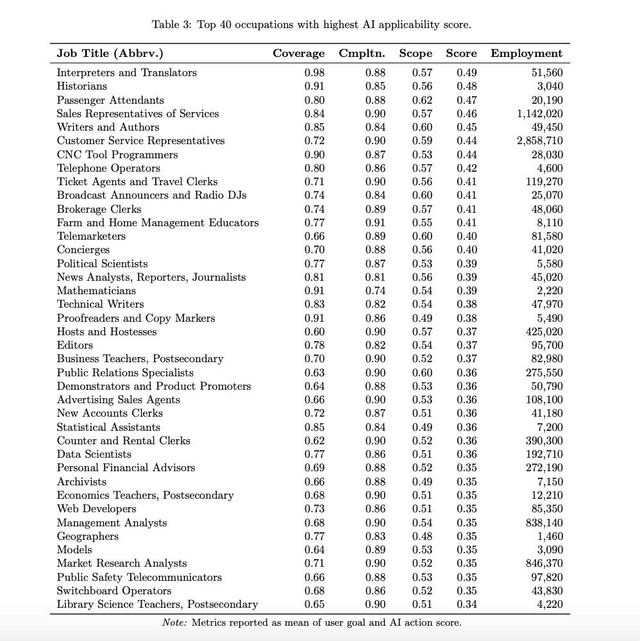
We encourage our clients to move forward quickly once they spot opportunities. Of course, carefully drawn plans for adoption are needed, but the opportunity for wholesale change by rewiring operations must be embraced. We recognize the disruption may feel existential for some parts of a company, but this is the nature of the change, where agents and systems can now handle activities at a ‘human scale’—something we’ve never witnessed before. Microsoft Research recently released their report on occupations most at risk from AI adoption—which, at least for some occupations, is existential. We excerpted the table below for your reference, sorted by occupation based on an applicability score.
Give us a call. We'd welcome the chance to share our AI enterprise experiences with you.