

- Published on
AI Time Complexity
- Authors
- Name
- Strategic Machines


When Time Hits Zero
A year ago, we wrote about AI Time—how AI-first companies are outpacing their traditional counterparts at unprecedented rates. Shortly after, we explored Time Price and George Gilder's radical idea: what happens when software—once a scarce and labor-intensive resource—can be generated in minutes, seconds or milliseconds?. Suddenly, time isn’t the constraint anymore. So if time is no longer money… is money now time?
That's the question we've been wrestling with this past year, watching the increasing precision, quality and outcomes from models like Claude, ChatGPT, Grok and Gemini: What happens when the time to create something approaches zero?
When AI Agents generate UIs in real-time, draft contracts, design products, restructure workflows or write an analysis faster than you can blink (or think?) — how do we reason about value anymore? This question has implications for everything from market pricing, and labor force management to product planning and delivery systems in the future.
The Developer's Nightmare (And Your Opportunity)
In computer science, there's a concept called Big O notation. It measures how an algorithm's performance scales as its workload grows. Developers joke about it as "Oh No!" when they discover their code slows to a crawl under pressure.

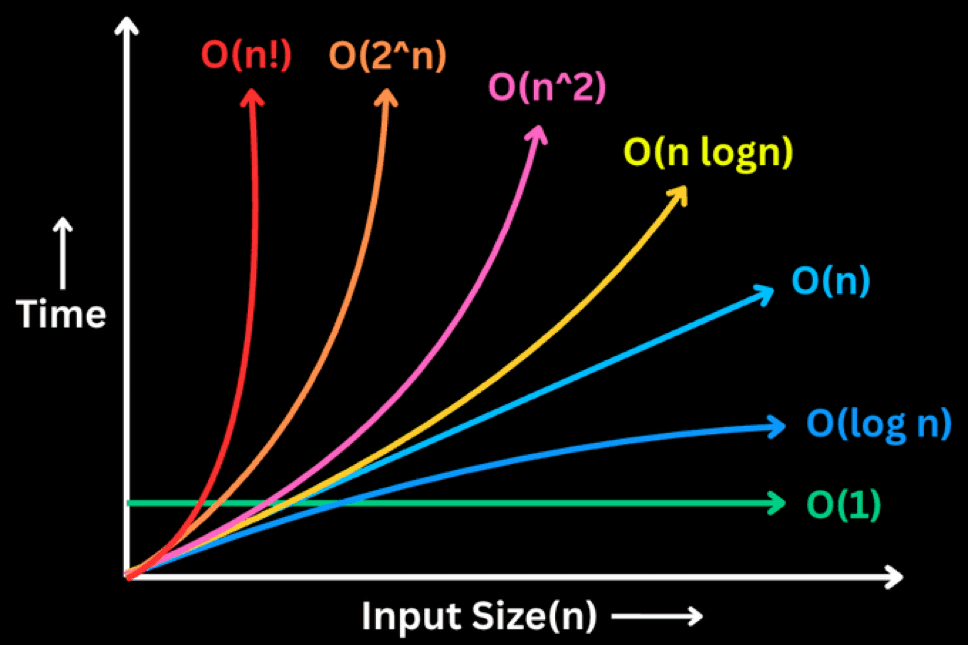
- O(1) means constant time—fast no matter what
- O(n) means linear—doubles the work, doubles the time
- O(n²) means quadratic—doubles the work, quadruples the time
This framework has served us well for decades. But AI is breaking it.
Beyond Time: The Event Economy
Traditional algorithms live in clock time. They tick through steps, one after another. AI models don't work this way. They exist in what we might call event time.
As Gilder puts it:
We are not talking about fast-interval processes, like high-frequency stock trading, but rather no-interval processes like real-time AI. When an event occurs, a function is triggered in real-time. Time in the past drove synchronized events. Events in the future deliver synchronized outcomes.
This is a profound shift. In the old world, we asked: How long does it take? In the new world, we ask: Did it arrive at the right moment?
From Measuring Time to Measuring Fit
When creation time approaches zero, a new framework emerges. We call it Event Value—and it has three simple dimensions:
1. Relevance — Is this the right output for this moment?
An AI can generate a response in milliseconds. But is it the right response? Relevance measures whether the output fits the event that triggered it.
2. Synchronization — Did it arrive when needed?
In event-driven systems, timing isn't about speed—it's about alignment. A perfectly crafted response that arrives too late has no value. The question isn't "how fast" but "how synchronized."
3. Impact — What outcome did it enable?
The ultimate measure. Did this event-triggered output lead to a sale, a decision, a satisfied customer? Impact looks forward, not backward.
The Inversion
Here's the shift in one sentence: We've moved from "time value" to "event value."
In the old economy, value accumulated through time investment. More hours, more effort, more value. The clock was the scorekeeper.
In the event economy, value emerges through synchronized outcomes. The right response at the right moment to the right trigger. The event is the scorekeeper.
This is why AI-first companies are scaling three times faster than traditional SaaS firms. They're not just doing things faster—they're operating in a different dimension of value creation entirely.
What This Means for Your Business
If you're still measuring AI projects by how much time they save, you're using an old map in new territory. Consider instead:
-
Design for events, not processes. What triggers should activate your AI systems? What outcomes should they synchronize toward?
-
Measure relevance, not just speed. A fast wrong answer is worse than no answer. How well does your AI understand context?
-
Think in outcomes, not outputs. The goal isn't to generate more content faster. It's to enable better decisions at the moment they matter.
The businesses that thrive in this new era won't be the ones with the fastest algorithms. They'll be the ones that master the art of synchronized value—delivering the right capability at the moment of need.
Seeing It In Action
At Strategic Machines, we are actively deploying AI agents for reservation desks, sales concierge, and customer support. These aren't just "fast" systems—they're event-driven systems designed for synchronized outcomes.
We invite you to try test agents we deployed. (All you need to do is request a 'one time password' and then select the 'people icon' at the bottom of iPhone to activate an agent. With the Cypress Agents, for example, you can plan a menu with a private chef, find a villa, inquire about amenities, and even reserve a room.)
We are combining the best design, the fastest tech, and the strongest business logic to build the future of conversational commerce.
Give us a call. We'd enjoy exploring what the event economy might hold for your business.
SOURCES AND REFERENCES
Time Price in AI - Strategic Machines